BIO-PLATEAUX Conference: Closer regional cooperation on the basins of the Guiana Shield

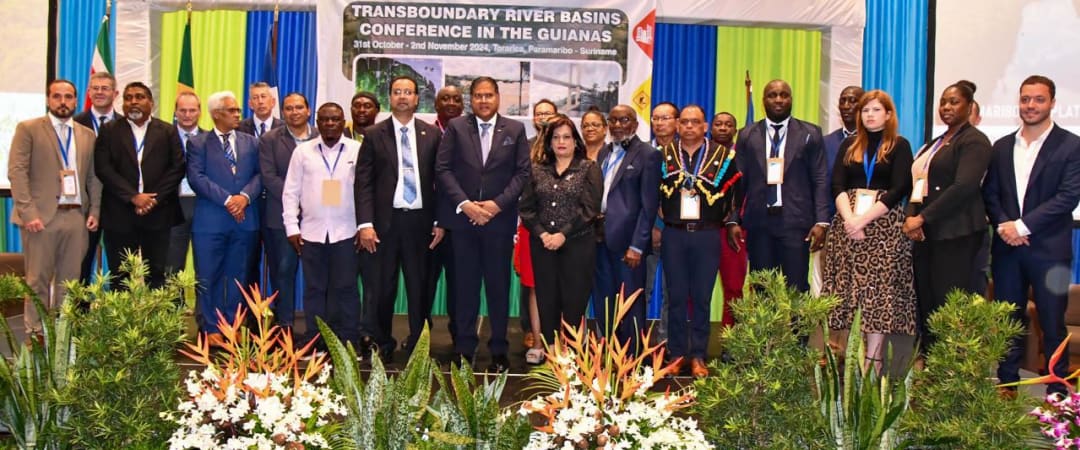
From 31 October to 2 November 2024, the city of Paramaribo (Suriname) hosted the BIO-PLATEAUX Regional Conference, an initiative dedicated to water management in the transboundary basins of the Guiana Shield. The meeting brought together representatives of the highest authorities in Suriname, including the President of Suriname, Chandrikapersad Santokhi, French Guyana and the State of Amapá in Brazil, as well as experts and local authorities, to strengthen cooperation on water resources and the preservation of aquatic biodiversity in this unique region.
The first day of the conference was marked by the signing of a bilateral agreement between French Guyana and Suriname to monitor water quality in the Maroni basin. This agreement represents a major technical step forward for environmental monitoring in this sensitive cross-border area.
In addition, the three countries (Suriname, France and Brazil) involved in the BIO-PLATEAUX project have signed a tripartite declaration in favour of the creation of a regional observatory. This observatory will be tasked with facilitating thesharing of essential data and information on the watersheds of the Guiana Shield, thereby supporting informed decision-making on issues relating to water,biodiversity and natural hazards.
The President of Suriname, Chandrikapersad Santokhi, and the Minister of Public Works, Riad Nurmohamed, together with Jean-Paul Fereira, Vice-President for Sustainable Development of the Territorial Collectivity of French Guiana (CTG), reaffirmed the importance of this cooperation for the well-being and resilience of local communities. OiEau, as coordinator of the BIO-PLATEAUX project.
Round tables and working groups to tackle regional challenges
The conference continued with discussions on the socio-cultural and environmental challenges facing the Guiana Shield.
On the final day, working groups focused on the specific issues facing the Maroni and Oyapock rivers. Discussions focused on a number of priority issues:
- Adaptation to climate change, in particular flood and drought management,
- River pollution, water quality monitoring and aquatic biodiversity;
- Access to essential services for water supply, sanitation and waste management.
A new partnership has also been signed between the BIO-PLATEAUX projectand the research community in the state of Amapá. The aim of this agreement is to pool resources, particularly in the context of reusing fishing nets that pollute the Oyapock.
Photos: Territorial Collectivity of French Guiana

Few examples of projects